Exposure of Moira Templeton at the Orient Cafe
Why Didn't They Ask EvansThe Exposure of Moira Templeton at the Orient Cafe turns a conversation about a possible pursuer into a sudden confrontation over identity, poisoned coffee, and a pistol. Frankie Derwent recognizes that Moira Nicholson has used the sighting of Roger Bassington-ffrench to send her companions away from their cups, and confronts her as the woman who has been hiding behind the name Mrs Templeton. The attempted poisoning becomes visible through an ordinary coffee cup; the attempted shooting makes the danger immediate and public.
Background and the sighting
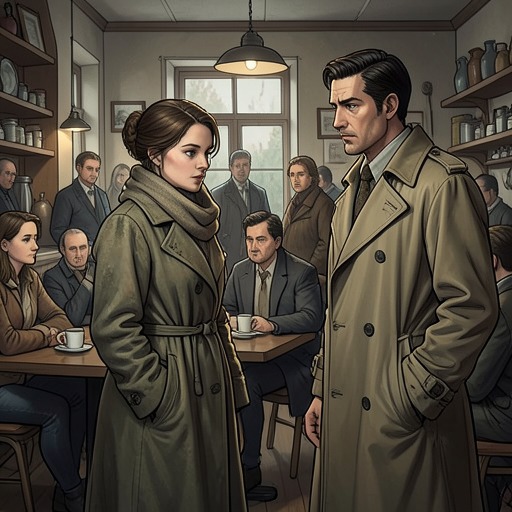
The scene begins with three cups of tepid coffee set before Bobby Jones, Frankie, and Moira. Moira says she hardly knows where to begin and starts to describe an encounter on the train to London. She breaks off while facing the door, leans forward, and says that a man must have followed her. When Bobby and Frankie ask who, she whispers the name of Roger Bassington-ffrench.
Moira says she has seen him outside with a red-haired woman. Frankie identifies the woman as Amelia Cayman. The sighting draws Bobby and Frankie out of the cafe at once; they run to the door despite Moira's protest and search up and down the street. Roger is nowhere to be seen. Moira joins them. The excursion has produced no confirmation of the sighting, but it has removed the two companions from the table and left their coffee unattended. In retrospect, that short interruption is the crucial circumstance of the attempted poisoning.
Frankie's inference and the coffee sample
When the group returns, Frankie reaches across an adjoining table to a cruet holding glass-stoppered bottles of oil and vinegar. She empties the vinegar into the slop bowl, then pours coffee from her own cup into the emptied bottle. Bobby, still focused on the oddity of her actions, asks what she is doing. Frankie explains that she is taking a sample for George Arbuthnot to analyse.
Frankie’s accusation rests on a particular sequence rather than on the sighting alone. She recalls jogging Bobby's elbow and making him spill his coffee as they stood at the door, then says that Moira’s face gave the game away. She concludes that Moira put something in their cups when she sent them to look for Roger. The sample makes the suspicion testable: instead of relying only on an accusation, Frankie preserves some of the coffee for analysis. The evidence in the scene does not identify the substance, and Frankie’s plan is to have it examined rather than claim that she knows precisely what it contains.
The false name exposed
Frankie addresses Moira as Mrs Nicholson, Mrs Templeton, or whatever name she chooses to use, rejecting the identity under which Moira has presented herself. Bobby is startled by the reference to Templeton. Frankie points to Moira's expression and proposes that, if Moira denies the accusation, they can take her to the Vicarage, where Mrs Roberts can identify her. The confrontation therefore turns on more than suspicious behavior at the table: Frankie claims that Moira's identity can be independently verified.
Moira's appearance changes as the accusation is made. Bobby sees the wistful face become one of rage; she curses them, then fumbles in her handbag. The shift from a feared woman speaking about a pursuer to an accused woman reacting violently sharpens the reversal. The scene does not show Moira answering the accusation or submitting to the proposed identification. Instead, her next action makes the threat unmistakable.
The pistol and the scene's consequence
Bobby is still dazed, but moves in time to strike Moira's pistol upward. The bullet passes over Frankie's head and embeds itself in the wall of the Orient Cafe. The shot does not hit either of them, but it confirms that the confrontation has become an immediate physical danger, not simply an argument about names or the contents of a cup. A waitress, who had not hurried earlier, rushes out into the street screaming for help.
The scene's decisive shift is from concealed interference to open violence. At first, the coffee is just one of three ordinary cups on a cafe table; Frankie's handling of the vinegar bottle makes it an object of suspicion and a possible source of evidence. Moira's movement toward her handbag then changes the stakes again, and Bobby's intervention prevents the pistol from being aimed directly at Frankie. The exposure is thus neither a calm confession nor a completed investigation: it is Frankie's inference, a sample set aside for analysis, an identity challenged, and a shot deflected before outside help is summoned.